Table of Contents
ToggleWhich Ayurvedic Medicine Is Best for Weight Loss?
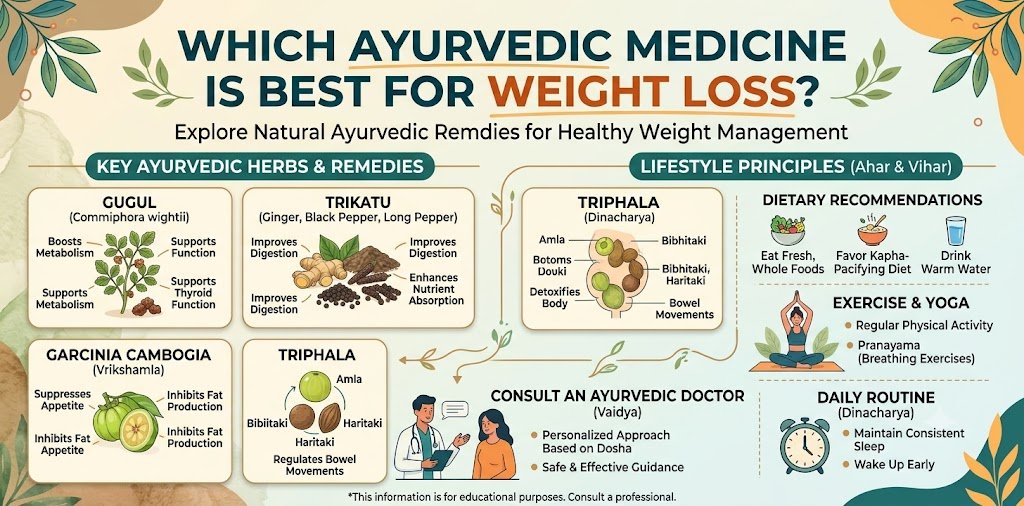
There isn’t one single “best” Ayurvedic medicine for weight loss — what works depends on your dominant dosha, your digestion, and honestly, which herbs actually have decent evidence behind them versus which are mostly tradition. The short answer: multi-herb formulations built around Guggul, Triphala, and Garcinia Cambogia tend to be the most commonly recommended, but it’s worth knowing which of these ingredients have real research support and which don’t before you buy anything.
How Does Ayurveda Approach Weight Loss?
Ayurveda doesn’t treat weight gain as a calories-in-calories-out problem the way conventional diet plans do. It’s framed around three things: Agni (digestive fire), Ama (undigested toxins that build up when Agni is weak), and dosha imbalance — mainly Kapha, which governs structure and lubrication in the body and is associated with sluggish metabolism when out of balance.
In plain terms: if your digestion is weak, food doesn’t get processed properly, waste accumulates, and that shows up as weight gain and low energy over time. So Ayurvedic weight-loss formulations aren’t really “fat burners” in the way a stimulant-based supplement is — they’re built to fix digestion and metabolism first, with fat loss as the downstream result. That’s a genuinely different mechanism than most people expect walking in.
What Are the Most Common Ayurvedic Herbs for Weight Loss?
Herb | Traditional Use | Evidence Snapshot |
Guggul | Supports fat metabolism, traditionally used for cholesterol balance | Some human trials exist, but results are mixed and mostly older/small-scale |
Triphala | Digestion and detoxification support (three-fruit blend) | Reasonably well-studied for digestive effects; less direct evidence specifically for weight loss |
Garcinia Cambogia | Appetite suppression via hydroxycitric acid (HCA) | Genuinely mixed — see the honesty section below |
Green Tea Extract | Metabolism support via catechins | Better-supported than most Ayurvedic herbs, though effect sizes are modest |
Fenugreek | Fibre content supports fullness, may reduce cravings | Reasonable evidence for appetite/fullness, not for direct fat loss |
Punarnava | Traditionally used for water retention and bloating | Mostly traditional use, limited modern research |
Black Pepper (Piperine) | Believed to improve bioavailability of other herbs | Some absorption-enhancement evidence, not weight loss on its own |
So, Which Ayurvedic Medicine Is Best for Weight Loss?
Given that framing, single-herb products tend to be weaker bets than combination formulations that pair a digestion-support herb (Triphala, Guggul) with a metabolism-support herb (Green Tea Extract, Fenugreek) and something for appetite (Garcinia, Piperine). That’s the logic most Ayurvedic weight-management ranges are actually built on, even when the marketing leads with “fat burner.”
Navyug Ayurveda’s weight management range is a decent example of this combination approach — their line includes Charbi Nashak and Fat Burner Capsules (both built around Garcinia Cambogia and Piperine), Fat Mukti (which adds Grape Seed and Fenugreek into the mix), and a Green Tea tablet for the metabolism-support side specifically. If you’re comparing options, formulations that stack multiple herbs like this are generally a more sensible starting point than a single-ingredient pill, precisely because no one herb here has strong enough standalone evidence to carry the whole job.
That said — “best” is genuinely body-type dependent in Ayurveda. Someone with a Kapha-dominant constitution (sluggish digestion, weight gain, water retention) often responds differently to these formulations than someone whose weight gain is more Vata- or Pitta-driven. This is exactly the kind of thing worth discussing with a practitioner rather than picking based on marketing copy alone.
Is There Real Evidence Behind These Herbs, or Just Tradition?
Honestly — it’s a mix, and Garcinia Cambogia is the one worth being most careful about. The U.S. National Center for Complementary and Integrative Health states plainly that it’s unclear whether garcinia cambogia products actually help with weight loss, and several systematic reviews have found the effect, if any, to be modest and clinically uncertain.¹ There have also been documented case reports of liver injury linked to garcinia cambogia supplementation, which is worth knowing before combining it with other supplements or if you have any existing liver concerns.²
That doesn’t mean these formulations are useless — Guggul and Triphala both have a longer track record and Green Tea Extract has comparatively decent modern research behind its metabolic effects. But “Ayurvedic” and “clinically proven” aren’t the same claim, and any formulation, from any brand, that promises guaranteed or rapid fat loss is overselling what the underlying herbs can actually deliver on their own.
Source: National Center for Complementary and Integrative Health (NCCIH) ² Documented in case reports published via NCBI/PubMed
How Long Does It Take to See Results?
Most Ayurvedic practitioners and formulation guides put this at 4 to 8 weeks for visible changes, and that’s consistent with how these herbs are understood to work — through digestion and metabolism correction rather than a direct, fast-acting mechanism. If a product promises results faster than that, that’s usually a marketing claim outrunning the biology, not a sign of a better formulation.
What Should You Combine Ayurvedic Medicine With for Best Results?
No herbal formulation — Ayurvedic or otherwise — works in isolation from the basics:
- Fibre-rich, whole-food diet — supports the digestive correction these herbs are meant to assist, rather than working against it
- Regular movement — even daily walks meaningfully support the metabolic side of this
- Consistent sleep and hydration — both directly affect Agni in Ayurvedic terms, and metabolism in conventional ones
- Stress management — chronic stress is repeatedly flagged across both Ayurvedic and modern sources as a driver of weight gain that supplements alone can’t fix.
Frequently Asked Questions
Which ayurvedic medicine is best for weight loss?
There’s no single best option — multi-herb formulations combining a digestion-support herb (like Triphala or Guggul) with a metabolism-support herb (like Green Tea Extract) tend to be a more sensible choice than single-ingredient products, but individual response depends on your dosha and overall health.
Is ayurvedic medicine for weight loss actually backed by science?
It’s mixed. Some herbs like Green Tea Extract and Triphala have reasonable modern research support; others like Garcinia Cambogia have genuinely uncertain evidence per NCCIH, despite being one of the most commonly used weight-loss herbs.
Are ayurvedic weight loss supplements safe?
Generally yes when used as directed, but Garcinia Cambogia specifically has been linked to rare cases of liver injury, so anyone with existing liver conditions or on other medications should check with a doctor first.
How long does ayurvedic medicine take to show weight loss results?
Most sources point to 4–8 weeks for visible changes, since these formulations work through digestion and metabolism correction rather than rapid fat-burning.
Can ayurvedic medicine for weight loss replace diet and exercise?
No — every credible source on this, Ayurvedic or conventional, treats herbal support as a complement to diet, movement, and lifestyle changes, not a replacement for them.
Your Opinion Matters—Rate This Post!
Click on a star to rate it!
Average rating 0 / 5. Vote count: 0
No votes so far! Be the first to rate this post.