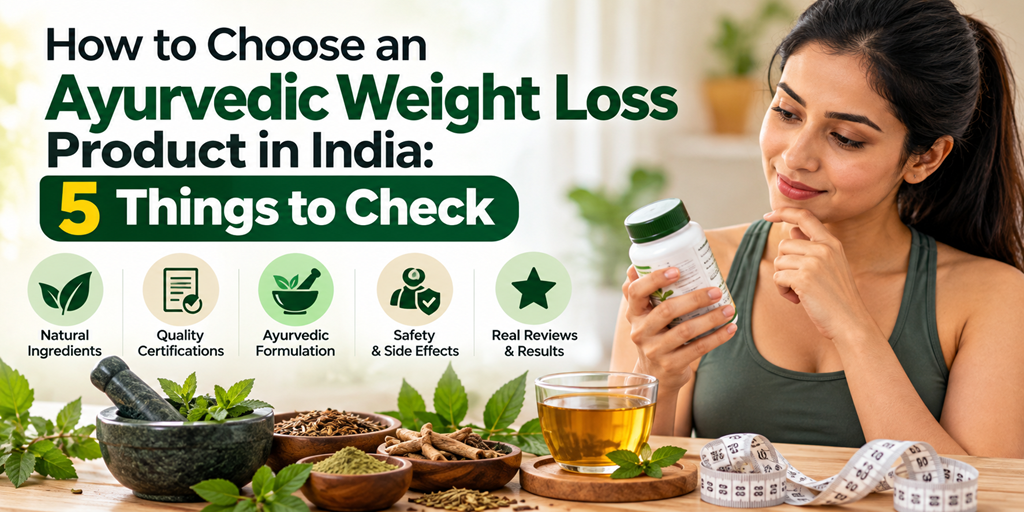
Before buying any Ayurvedic weight loss product in India, check five things: a full ingredient list with quantities, a printed AYUSH licence and GMP certification, a formula that works on more than one mechanism, claims and timelines that sound realistic, and clear safety information. If a product fails two or more of these, keep looking.
Most people compare products by price, reviews, or the size of the promised result. None of those tell you what’s actually in the bottle. The five checks below take a couple of minutes and work on any product, from any brand.
Table of Contents
Toggle1. Does the Label Show Every Ingredient and How Much of It?
A trustworthy label lists each herb by name along with the quantity per capsule or dose, usually in milligrams. Vague phrasing like “proprietary blend” or “herbal complex” with no individual quantities is a genuine red flag, not just a formatting choice. It usually means you can’t tell whether an active ingredient is present in a meaningful dose or just added in trace amounts for the label.
Compare this against a reference like Guggul, Triphala, or Garcinia Cambogia, all of which have known traditional dosage ranges. If a product’s total capsule weight can’t reasonably account for the ingredients it claims to contain, that’s worth a second look before you buy.
2. Can You Verify the AYUSH Licence and GMP Certification?
Every legitimate Ayurvedic product sold in India needs a manufacturing licence issued under the AYUSH system, along with GMP (Good Manufacturing Practice) certification from the facility that makes it. The licence number should be printed on the label, not just claimed somewhere on the website.
You can cross-check a licence number with the relevant state licensing authority (Ayurvedic products are licensed state-wise in India). It takes a few minutes, and a product that resists this kind of verification, or where the number doesn’t match up, isn’t one to trust with your money or your health.
3. Does the Formula Match How Weight Gain Actually Works?
Weight gain isn’t caused by one single mechanism, so a credible formula usually targets more than one: digestion, metabolism, and appetite, rather than relying on a single herb to do the whole job. Combination formulas that pair a digestion-support herb (like Triphala or Guggul) with a metabolism-support herb (like Green Tea Extract) tend to be a more sensible starting point than single-ingredient pills.
Worth knowing before you buy: the U.S. National Center for Complementary and Integrative Health states plainly that it’s unclear whether Garcinia Cambogia, one of the most commonly used weight-loss herbs, actually helps with weight loss.¹ That doesn’t make it useless, but it does mean no single herb here has strong enough standalone evidence to justify a product built entirely around it. A wider formula, or realistic expectations about what any single ingredient can deliver, matters more than the marketing copy around it.
¹ Source: National Center for Complementary and Integrative Health (NCCIH)
4. Are the Claims and the Timeline Believable?
Herbal weight-management formulas work through digestion and metabolism support, which is a gradual process. Most credible sources put visible results at 4 to 8 weeks of consistent use, alongside diet and lifestyle changes. Anything promising results meaningfully faster than that is usually leaning on a stimulant effect rather than genuine metabolic correction, whatever “Ayurvedic” label is on the bottle.
A few claims should make you walk away, or at least slow down and read the fine print:
- A specific number of kilos promised in a week
- “No side effects” or “100% safe” stated as a flat guarantee, since no supplement, herbal or otherwise, can honestly claim zero possibility of a reaction in every person
- Results promised without any change to diet or activity
- Before/after photos with no context on timeline, diet, or whether they’re even the same product
None of these are automatically disqualifying on their own, but two or more together are a real pattern worth noticing.
5. Does It Tell You Who Shouldn’t Take It, and Can You Reach a Doctor?
A responsible product will say clearly who should avoid it or check with a doctor first, typically pregnant or breastfeeding women, and anyone managing diabetes, thyroid conditions, or liver issues. Several common weight-loss herbs interact with metabolic and hormonal processes, so this isn’t a formality; it’s a genuine safety check.
Garcinia Cambogia specifically has been linked in rare case reports to liver injury, documented in case-report literature via NCBI/PubMed.² That’s a reason to check with a doctor before combining it with other supplements or medication, not a reason to avoid every product that contains it, but it’s exactly the kind of thing a product’s safety information should mention rather than bury.
Beyond the label, check whether the brand gives you an actual way to reach a qualified practitioner (a real BAMS doctor, not just a chat widget) if you have questions before or during use. That access matters more than most buying guides give it credit for.
² Documented in case reports published via NCBI/PubMed
The Five Checks at a Glance
Check | What Good Looks Like | Walk Away If |
Ingredient list | Named herbs with quantities per dose | “Proprietary blend” with no quantities |
AYUSH licence & GMP | Licence number printed and verifiable | No licence number, or it doesn’t check out |
Formula logic | Multiple mechanisms (digestion, metabolism, appetite) | Single herb asked to do everything |
Claims & timeline | 4-8 weeks, realistic language | Rapid results, “guaranteed,” no diet/exercise needed |
Safety information | Named contraindications, doctor access | No mention of who should avoid it |
What Does One Ayurvedic Range Look Like Against This List?
Take Navyug Ayurveda’s weight management range as a working example, since it’s built from combination formulas rather than single-herb products:
Product | Key Herbs | Price |
Charbi Nashak | Garcinia Cambogia, Piperine | ₹999 |
Fat Burner Capsules | Garcinia Cambogia, Green Coffee | ₹999 |
Fat Mukti Capsules | Garcinia Cambogia, Grape Seed, Piperine, Fenugreek | ₹999 |
Green Tea Tablets | Green Tea Extract, Grape Seed, Lemongrass Oil | ₹499 |
Three of these four lean on Garcinia Cambogia as a core ingredient, so the evidence caveat in Check 3 applies here as much as it does to any other brand using it. The range does offer a free consultation with a practitioner, which covers Check 5’s access requirement.
As with any brand, it’s worth checking the actual product you’re holding against Checks 1 and 2 yourself: exact ingredient quantities per capsule and the printed AYUSH licence number on-pack.
Frequently Asked Questions
How do I know if an Ayurvedic weight loss product is genuine?
Check for a printed AYUSH manufacturing licence number and GMP certification, and verify the licence with the relevant state licensing authority. A genuine product won’t resist this kind of check.
What ingredients should I look for in an Ayurvedic weight loss product?
Combination formulas pairing a digestion-support herb (Triphala, Guggul) with a metabolism-support herb (Green Tea Extract) tend to be a more sensible choice than single-ingredient products, since no individual herb has strong enough standalone evidence to carry the job alone.
How long does it take for Ayurvedic weight loss products to work?
Most credible sources point to 4 to 8 weeks of consistent use alongside diet and lifestyle changes. Anything promising faster results is usually overselling what the underlying herbs can do.
Are Ayurvedic weight loss products safe for everyone?
Not automatically. Garcinia Cambogia specifically carries rare liver-injury risk in case reports, and several weight-loss herbs interact with thyroid, diabetes, and hormonal conditions, so anyone with an existing condition or on medication should check with a doctor first.
Does more herbs in a formula always mean a better product?
No. What matters is whether the herbs included address different mechanisms (digestion, metabolism, appetite) at meaningful doses, not the total count of ingredients on the label. A long ingredient list with no quantities is often a weaker sign than a short, well-dosed one.
Where to Go From Here
Screenshot the table above, or keep this checklist open the next time you’re comparing products, whichever brand you’re looking at. Five checks, a couple of minutes each, and you’ll know more about what you’re buying than most reviews or rankings will tell you.
Your Opinion Matters—Rate This Post!
Click on a star to rate it!
Average rating 0 / 5. Vote count: 0
No votes so far! Be the first to rate this post.